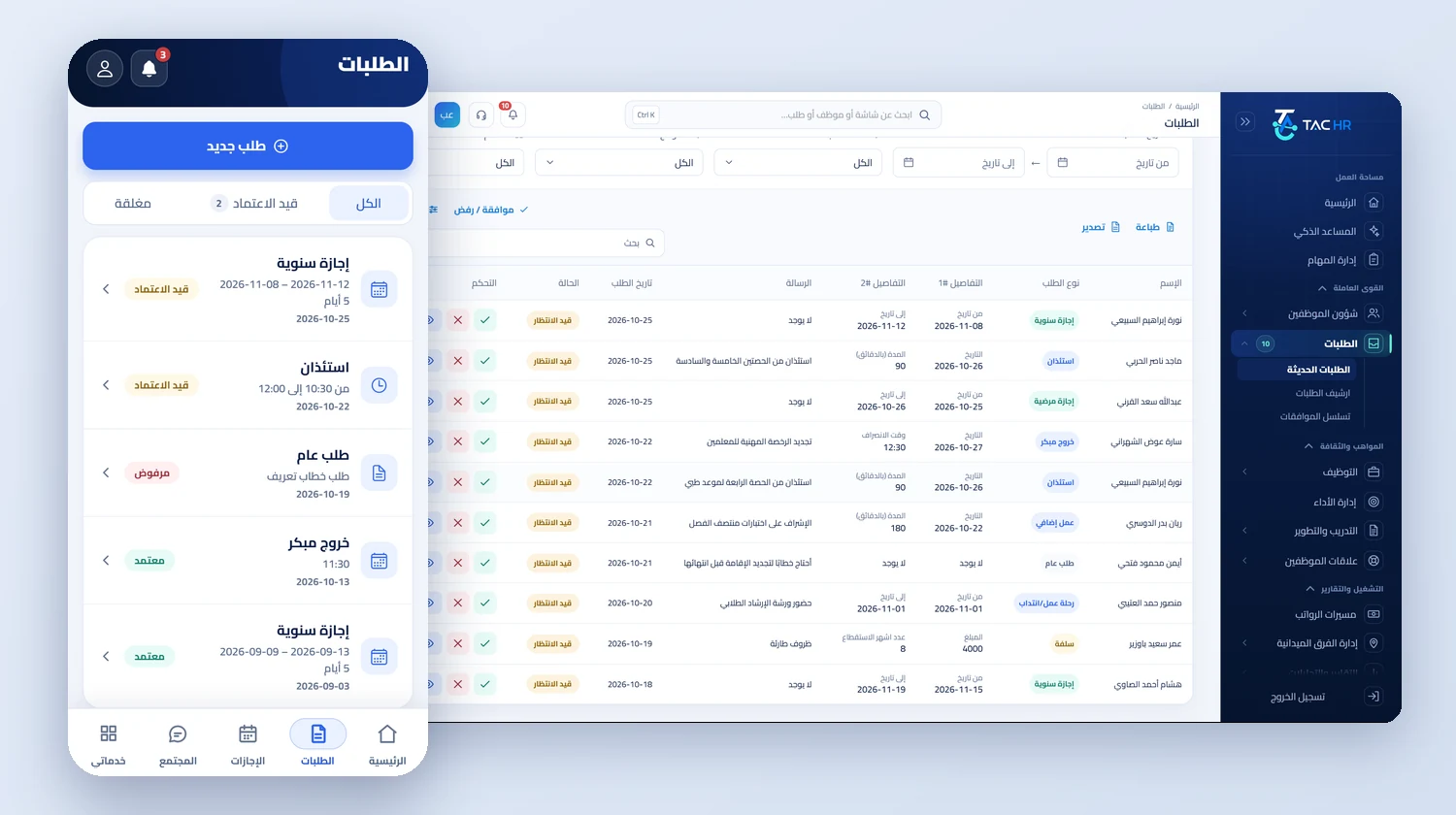
Inside the platform
A private school works to a calendar unlike any other: a school year with its terms, contracts that renew before each year, and two staff groups whose hours differ. Its HR work piles up in two months, before the year and after it ends. So TAC HR builds the repeating work on dates, not on memory: a shift for each group, a renewal proposal that opens before a contract ends, an alert before every document, and a settlement worked out by formula. This page explains how that runs in a school with teachers and administrators, and what stays outside the system.
01
Two groups, two shifts
Every employee has a shift with a start and end time, a lateness grace, an early-leave grace and rest days of its own. A teachers' shift is defined to start before assembly and an administrators' shift to follow office hours, and an employee can have more than one shift a day if they work mornings and evenings. A teacher who arrives at 07:05 for a shift that starts at 06:45 is 20 minutes late before the shift's grace, and that is never counted against anyone else. When the new year starts with different hours you schedule a change to the shift with its effective date, it applies on its day and stays as a record that is never deleted. Official holidays enter the calculation, so their day is not counted as absence.
02
Contracts before the year starts
A daily job checks each employee's contract end date and alerts admins before it on the company's lead times, 60, 30 and 7 days by default, and the employee gets an alert themselves 30 days and then 7 days before. Another job then opens a renewal proposal 45 days before the end in HR's decisions inbox, once per contract: a renewal extends the contract date by the proposed term and notifies the employee, while a non-renewal closes the proposal with no silent extension. The employee is told nothing before the decision, so an internal suggestion never turns into a promise.
03
A teacher's documents and letters
A teacher's documents go into their file each with its expiry date: contract, iqama, medical insurance and passport, and the professional card is uploaded with its type and date so it enters the same alerts, while a document renewal request of its type goes through the approval route. The system does not connect to the licence body, so the alert rests on the date entered. From the teacher's phone they request a salary letter, an employment letter, an experience letter or a copy of their contract, which reaches HR through an approval route, and after approval the letter is generated as a PDF with Hijri and Gregorian dates and saved in their documents.
04
Review and development
A review cycle is launched with criteria and weights the school sets, with ready templates including one for a general employee and one for the end of probation. The teacher reviews themselves, their manager reviews them, and an anonymous 360 review can be added that is never shown under three reviewers. Results are calibrated with a written reason, then approved and reach the teacher in their app to acknowledge. Whoever needs support gets an improvement plan with tasks, a duration and a decision at its end. Training offers courses with text, image, video, PDF and quiz lessons, development paths, and a completion certificate saved in the teacher's documents.
05
End of contract and settlement
When a teacher's contract ends or they resign, a settlement is prepared that gathers unpaid salary days, unused leave balance and the end-of-service award, and deducts loans and unreturned custody. The award is worked out on the hire-date anniversary: a teacher on SAR 8,000 whose contract ended after six years is owed SAR 28,000.00, half a month for each of the first five years and a month for the sixth, and if they resign after the same period they get two thirds of that, SAR 18,666.67. End of service takes effect on the last working day, not the moment of approval, so they stay on the job and the run counts them until that day.