Inside the platform
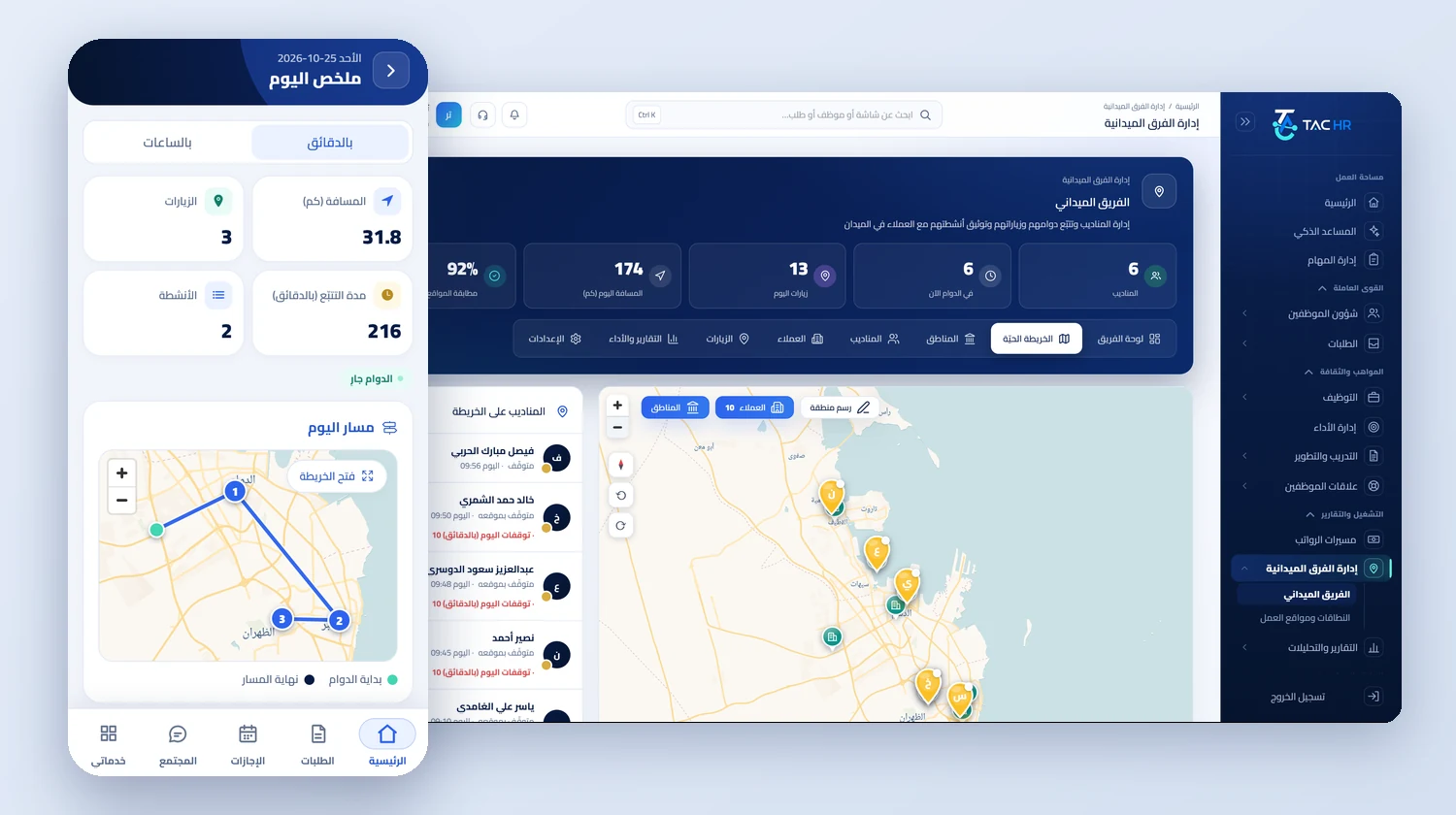
A transport company runs two kinds of attendance at once: fixed attendance for those tied to a site, and moving attendance for those who work on the road. Running them on two systems means two sheets and two payrolls merged by hand at month end, and running them on one means each employee gets the service that suits them and a single record. So TAC HR treats the driver as an ordinary employee with field tracking switched on, and the warehouse worker as an employee with a geofenced punch, and the run reads both. This page explains how that runs in a company with a warehouse and drivers, and what stays outside the system.
01
A warehouse with a boundary and a gate device
Every warehouse has a boundary drawn on the map as a polygon or a circle, and its staff have a punch place of one location, several locations or anywhere, with each employee's own setting overriding the company's. At a phone punch the system checks the location against the boundary, rejects what falls outside with its reason and distance, and inspects the device and spoofed location first. At the loading gate a ZKTeco device can be used, for which the system generates a private key, keeps a log of every connection it refused, so someone without a smartphone can punch. Staff have a shift with its grace, so lateness and overtime are worked out on their shift.
02
A driver on a field shift
No separate account is created for the driver. An admin switches on the field employee toggle in their file within the rep seats in the subscription, and they see their field screens in the same employee app. Before the first field shift the app asks for their consent to location tracking during the shift, and the shift cannot start without it. The shift starts with an attendance punch with all its checks, and at that point their dot appears live on the supervisor's map: moving, stopped or in a visit, and the day's path drawn on the roads. Tracking stops at clock-out or when the shift closes at the check-out cut-off, so the phone does not keep sending its location after working hours.
03
Delivery points
Every customer or unloading station is a record with a tier, a status, several locations and contacts, and a Google Maps link that pins its location, and whatever a driver adds from the field waits for management approval. On arrival the driver picks the customer and the location, the system measures their distance from the approved point against a radius the company sets between 20 and 2,000 metres, 150 by default, and the visit is marked inside, outside or unconfirmed by the accuracy of their fix. Then they record a delivery activity with its reference, or a collection or a complaint, from eleven ready types. Activities are a record, not accounting, and the system does not work out driving hours.
04
Driver licence and iqama
A driving licence is one of the employee document types and is uploaded with its expiry date alongside the iqama, medical insurance and contract end. Each document moves through its stages on the company's lead times, 60, 30 and 7 days by default and then expiry, so admins receive one daily summary and the driver gets a phone notification for their licence and iqama. A licence that expires on 1 March 2027 enters the first stage on 31 December 2026, the second on 30 January and the third on 22 February. The system does not connect to the traffic authority, so the alert rests on the date entered, and whoever's document expires raises a document renewal request.
05
Trips, overtime and the run
Someone sent on a trip to another city raises a business trip request with its destination and dates, so the days are not counted as absence, and a daily trip allowance is worked out if the company set one: five days at SAR 200 a day come to SAR 1,000.00 as a separate line with its formula. Overtime is by approved assignment by default, and under the Saudi labour law model on basic pay an overtime hour is paid at 1.5 times the normal hourly rate: a driver on a SAR 3,200 basic has a normal rate of SAR 13.33 and an overtime hour of SAR 20.00, so fifteen approved hours are worth SAR 300.00. The warehouse staff with their attendance sit in the same run, so the accountant does not merge two sheets.