TAC HRTAC HR
A woman and a manager reviewing a tablet in a hotel lobby
Industry solution

HR System for Hotels

Three shifts a day with a handover recorded to the minute, housekeeping tasks with due dates, and a season handled through fixed-term contracts

A hotel never closes. The night receptionist hands over to a colleague in the morning, housekeeping starts when guests leave, and the breakfast kitchen opens before anyone is awake. TAC HR gives each department its shifts and works out lateness on every handover, assigns housekeeping tasks with due dates and escalation, and follows the season's contracts to the last working day.

Today's reality

What happens in this industry without a system

  • 01The night employee takes over from the evening colleague, and if they are minutes late the colleague stays past the end of their shift with no record to prove it
  • 02Each department has its own pattern across shifts: reception has three, housekeeping has one daytime shift, room service sits between the two, and the pattern gets lost in a single sheet
  • 03In the season the hotel brings in staff on short contracts, and nobody remembers whose iqama or contract ends during the busiest days of occupancy
  • 04A task to prepare a suite for a delegation is handed over verbally or by message, and nobody knows it was not done until the delegation arrives
  • 05Leave requests pile up in one week around the seasons and public holidays, and they are approved with no control and no ceiling
With the platform

What changes in your working day

  • Named shifts for each department

    The morning, evening and night shifts are defined with a start and end time, a grace and rest days, assigned by department, and lateness is worked out on the employee's shift.

  • A handover recorded to the minute

    The check-in and check-out punch for every shift records its time and place, so you know who was late taking over and how long their colleague stayed past the end of their shift.

  • An emergency shift for a crowded day

    For an event or a delegation's arrival the company allows a temporary work shift on the same day, with its times recorded, counted toward working hours or counted as overtime.

  • Housekeeping tasks with due dates

    Lists with an owner, a priority, a due date and a location column, a reminder a day before and on the due date and an escalation after it, and completion from the employee's phone.

  • Season contracts to the last day

    The system follows the contract, iqama and health certificate dates, opens a renewal proposal 45 days before the end, and end of service takes effect on the last working day.

  • Leave through a route, with limits

    Every request type has an approval route, the company can set limits for automatic approval if it wants, and approved leave shows in the attendance report as leave, not absence.

Inside the platform

How it actually works in your company

Managing hotel staff is really managing a continuous handover between shifts. When the night employee is late taking over their colleague stays on, when a room is prepared late check-in is delayed, and when a seasonal contract ends in the busiest days of occupancy the whole department wobbles. So TAC HR builds on what can be measured: a punch for every shift with its time and place, a task for every job with its due date, an alert before every contract and document, and a run that reads all of it. This page explains how that runs in a hotel with three shifts and a season in which the team doubles, and what the system does not do.

01

The handover between shifts

Every shift has a start and end time, a lateness grace, an early-leave grace and rest days of its own, so reception gets a morning, evening and night shift, housekeeping gets a daytime shift, and they are assigned by department, with more than one shift for someone who works two. A night receptionist who arrives at 22:15 for a shift starting at 22:00 is 15 minutes late on their shift. The check-out punch for a shift that crosses midnight stays open until three hours after its end. The net week for such a shift: six nights between 22:00 and 06:00 with a 60-minute break give 420 minutes a night and 2,520 minutes a week.

02

The crowded day and overtime

For an event or a delegation's arrival the hotel needs work after the end of the shift, so the company allows a temporary work shift on the same day, a setting that is off by default, and picks how it counts: time recorded only, within working hours, or as overtime. The overtime source is an explicit setting: approved assignments only is the default, so only time approved by an overtime request is paid. Under the Saudi labour law model on basic pay an overtime hour is paid at 1.5 times the normal hourly rate: an employee on a SAR 4,500 basic has a normal hourly rate of SAR 18.75, so ten approved peak-season hours appear on their payslip as a separate line worth SAR 281.25 with its formula.

03

Housekeeping and maintenance tasks

The tasks section has lists whose columns you set yourself from five types, text, number, status, date and location, and ready templates including Maintenance work with a location column, a priority and an estimated cost. A task is assigned to an employee with a due date, who gets a reminder a day before and another on the day, and if it runs late and reaches the escalation grace, two days by default, the escalation reaches the department manager. The employee completes the task from their phone with a completion step. So the manager knows from the morning which suite has not been prepared, not when the delegation arrives.

04

The season and its contracts

Each employee's file carries the end date of their contract, iqama, passport and insurance, and those dates and the uploaded documents, including the health certificate for whoever works in the kitchen and restaurant, drive alerts on the company's lead times, 60, 30 and 7 days by default. 45 days before a contract ends the system opens a renewal proposal for the manager to decide: a contract ending on 31 December 2026 has its proposal opened on 16 November 2026, and if renewal is chosen the date is extended by the proposed term, and if non-renewal is chosen the proposal closes with no silent extension. A seasonal employee's end of service takes effect on the last working day and a settlement is prepared for their dues.

05

Leave and the run

Every request type has an approval route, from annual and emergency leave to Hajj leave, overtime and work-time change. The company can set an automatic approval rule for a given type with a per-request limit and a monthly limit, which is off by default, and anything past the limit goes to the approver. Approved leave shows in the attendance report as leave, not absence. At month end one run is created with the attendance of all three shifts, their overtime and their leave as separate lines, a payslip reaches every employee's phone, and the wage file comes out after IBAN and ID checks.


Inside the interface

The screen as your team uses it

HR System for Hotels
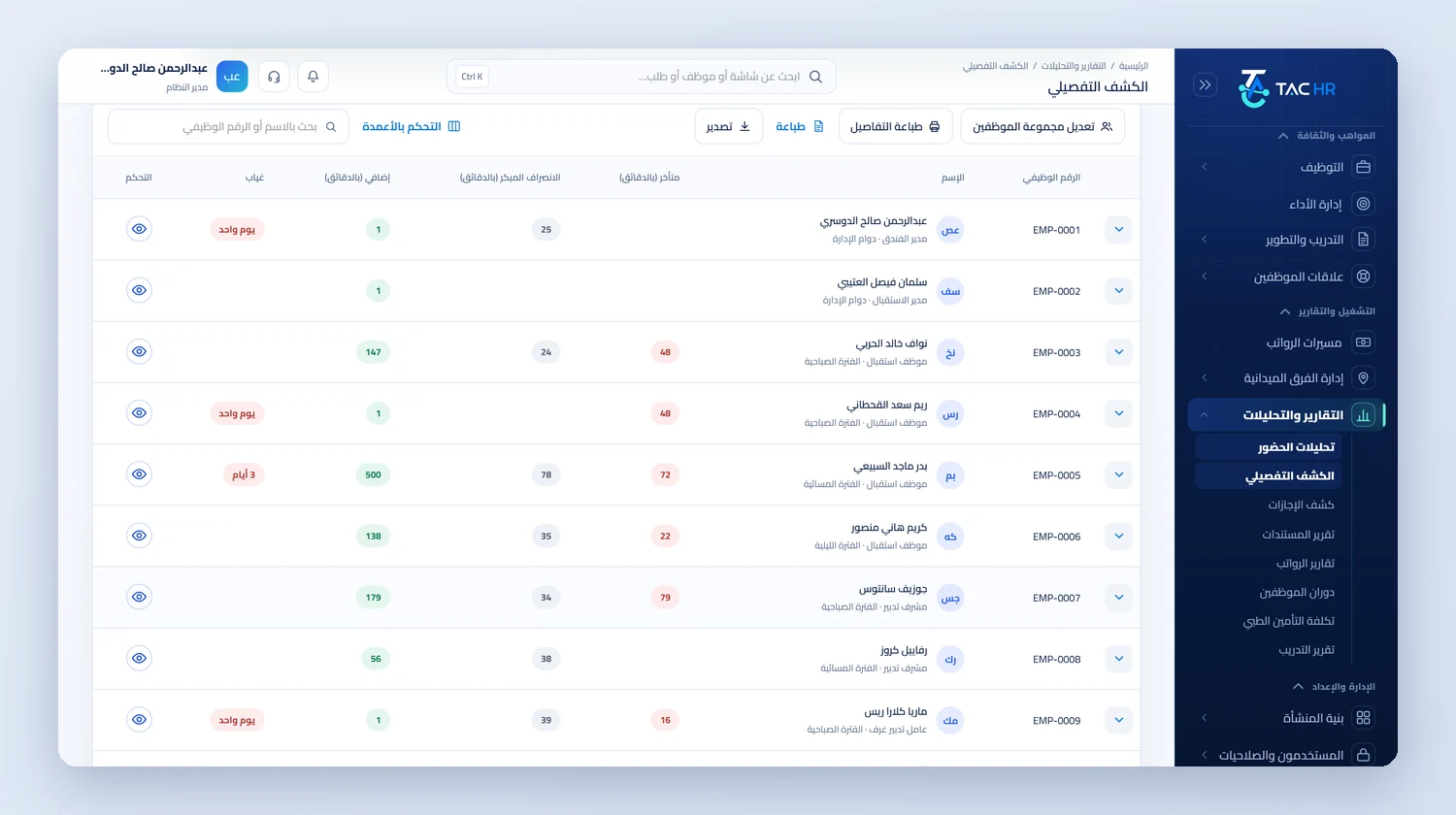
The detailed statement in reports with a table of employees showing each employee's number, name, job title and shift, minutes of lateness, early leave and overtime and days of absence, and the print, export and edit-employee-group buttons
An operating day

How the day runs on the platform

  1. 01

    Before the season

    The manager sees the season's contracts and the iqamas nearing expiry, and the season's posts go on the jobs page and applicants are screened

  2. 02

    The handover shift

    The night receptionist punches on taking over, lateness is worked out on their shift if there is any, and the manager sees who has not punched

  3. 03

    During the day

    Housekeeping and maintenance tasks go out with an owner and a due date, get completed from the phone, and late ones are escalated after the grace

  4. 04

    Month end

    One run is created with everyone's shifts, whoever finished a seasonal contract is settled, and the payslip reaches every employee's phone

The numbers

What the system works out for you

The figures come from a hypothetical example, computed by the system's own functions. The effect on your company is something you measure after rollout.

15 minutes
Lateness for a night receptionist who arrived at 22:15 for a shift starting at 22:00, counted on their shift and shown in the attendance sheet and then in the run as a separate line
2,520 minutes
The net week of a night reception rota of six nights between 22:00 and 06:00 with a 60-minute break, 420 minutes a night
SAR 281.25
Pay for 10 approved overtime hours in the peak season for an employee on a SAR 4,500 basic, at an overtime rate of SAR 28.13 an hour shown with its formula on the payslip

Limits of what the platform offers this industry

The system does not build the rota automatically and does not distribute employees across departments: shifts are defined and assigned. Housekeeping stays in task lists, not a reservation system: the system does not read room occupancy or guest status. Seasonal renewal needs your decision, so the system opens a proposal and never extends a contract on its own. The health certificate is a document uploaded with its date that the system alerts before, and it does not verify it with any body. A punch is never recorded without an internet connection.

Industry questions

What this industry asks before deciding

Does the system support the night shift that crosses midnight?

Yes. A shift is defined with a start time and an end time, lateness is counted from its start, and its check-out punch stays open until three hours after its end so it is not counted as forgotten. Attendance is attributed to the shift assigned to the employee.

Can an employee work at more than one of the hotel's branches?

Yes. Each employee gets a punch place: one location, several locations you choose, all the company's locations, or anywhere. Branches sit under one company and each location has its boundary on the map, and each company's data is isolated from the others.

How do I plan the month's rota?

Shifts are defined and assigned to employees, and an employee changes their shift with a work time change request that goes through approval. The system does not build the rota automatically, so management decides who works which shift.

What happens when a seasonal employee's contract ends?

45 days before the end the system opens a renewal proposal that the manager decides, and it never extends the contract on its own. If it is not renewed their service ends on the last working day, a settlement is prepared for their dues, and their attendance record is kept.

Request a demo on your own operation

We tailor the demo to your hotel's departments, shifts and season team, and start with what disrupts the handover today: punching, housekeeping tasks or season contracts.