Inside the platform
In a technology company people are measured by what they deliver rather than by the hour they arrive, but attendance does not disappear: client contracts and support rotas need a record, and the challenge is to set attendance without choking the team. So TAC HR is built on three things: flexible hours with a target for whoever is not measured by arrival time, performance measured by goals, check-ins and a 360 review that merge into one score, and tasks and data that the company opens to its tools with keys. This page explains how that runs in a technology company, and what the system does not measure.
01
Flexible hours and on-call
An employee's resolved schedule is either a fixed shift or target hours, so someone with a daily target of hours, on their file or on the company, works flexible hours: no lateness or early leave, and their shortfall against the target is counted from the first check-in to the last check-out. A developer with a target of 8 hours who punched in at 09:40 and out at 17:10 is 30 minutes short with no lateness at all. Support has a night shift whose check-out punch stays open for three hours after it ends. For someone working remotely the punch place setting is anywhere with no location check, or several sites, or one site, and the employee's setting overrides the company's.
02
Goals and check-ins
A goal has two levels: the goal and its key results under it, weighted, measured as a percentage, a target number or a completed state, and clamped between 0 and 100. A developer's goal with key results of 8 of 10 weighted 50, 90% weighted 30 and a completed result weighted 20 comes to 87. An admin can always update a goal, and an employee updates their progress from the phone if they are allowed, with each update a row recording who made it. A manager links a goal to a cycle so it feeds the goals criterion there. A manager also holds a periodic check-in with their employee on their goals, quarterly by default, recording progress, obstacles, agreed actions and the next check-in date, and the employee is notified.
03
One score
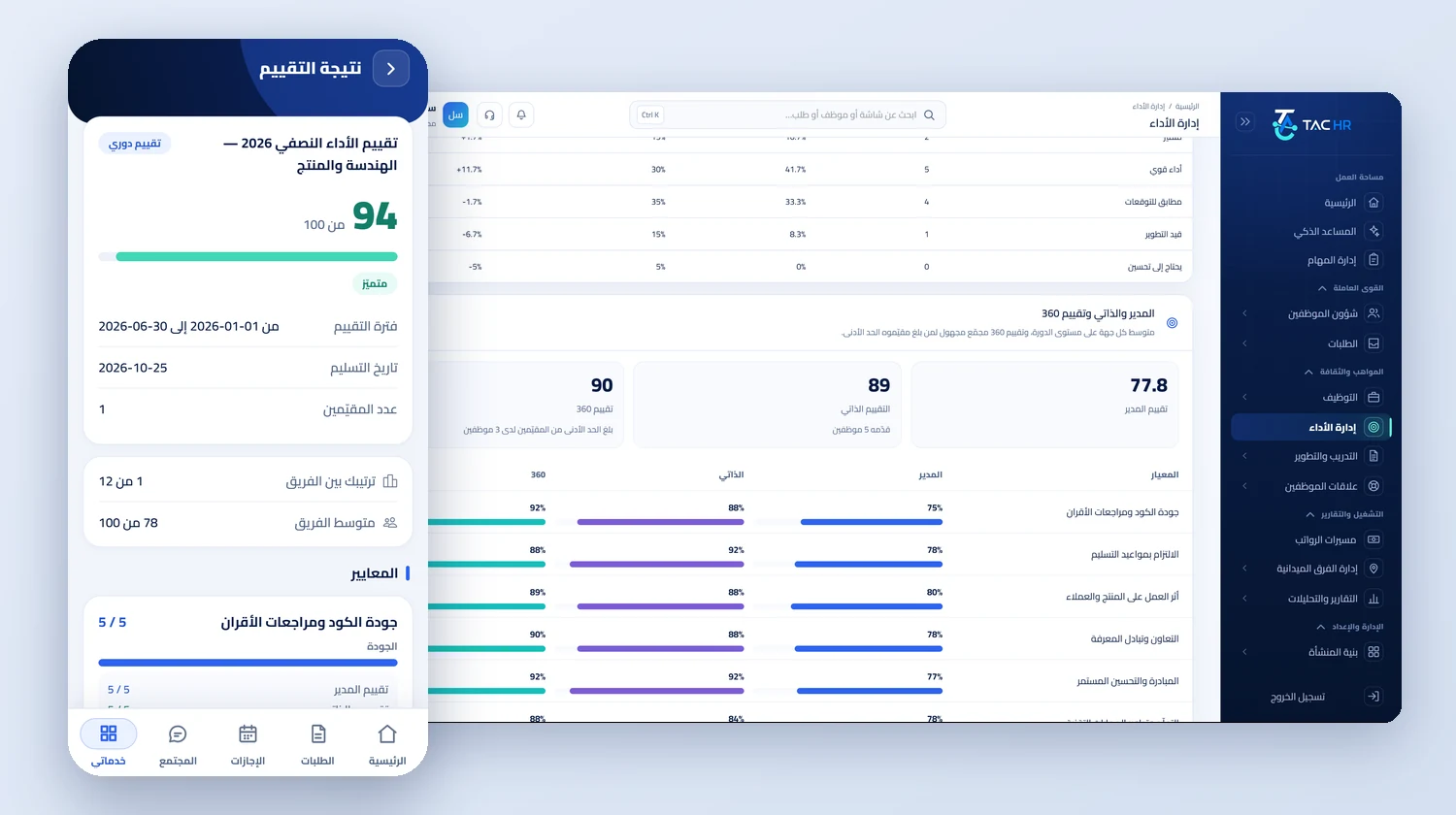
An employee's result in a cycle is worked out from the average of the reviewers' totals, then the cycle's goal achievement is merged in by its share of the weights, then the self review by its weight up to 50%, then the anonymous 360 review by its weight up to 30%. A developer whose reviewers average 80, with a goals share of 40% and goal achievement of 87, scores 83. If their 360 review is 90 at a 20% weight it becomes 84, with the verdict Strong performance. A 360 and its comments are not shown under three reviewers so nobody can infer who wrote them, and whoever holds the calibration permission adjusts the final score with a mandatory reason written in the calibration log, and the difference is recorded if the result was already delivered.
04
Support tasks and hiring
Internal support requests and new-hire device setups are task lists with columns you set from five types: text, number, status, date and location. A task is assigned to an employee with a due date, and they get a reminder the day before it and another on the day, and if it reaches the configured escalation grace, two days by default, the escalation goes to its creator and the employee's direct manager. They complete it from their phone and comment on it. In hiring a job is posted with an on-site, hybrid or remote workplace and an employment type that includes fixed-term and freelance, and the applicant moves through stages from new applicants to offer and hired, while automatic screening ranks applicants with a score and reasons and rejects nobody.
05
Your data in your tools
The company creates read keys with a scope per key: reading employees, attendance, or the payroll summary, and the company is taken from the key and not from the request, keys are stored only as a hash and shown once when created, and the request limit is 120 a minute. Reading employees carries no salary fields. A secure encrypted address can be registered to receive signed notifications when an employee is created or leaves, a request is approved or rejected, a run is paid or a punch is rejected, and the signature covers the timestamp and not the body alone, so an old message that was replayed is not accepted. Permissions come as admin groups and a scope by branch or department, so a team lead sees their team.