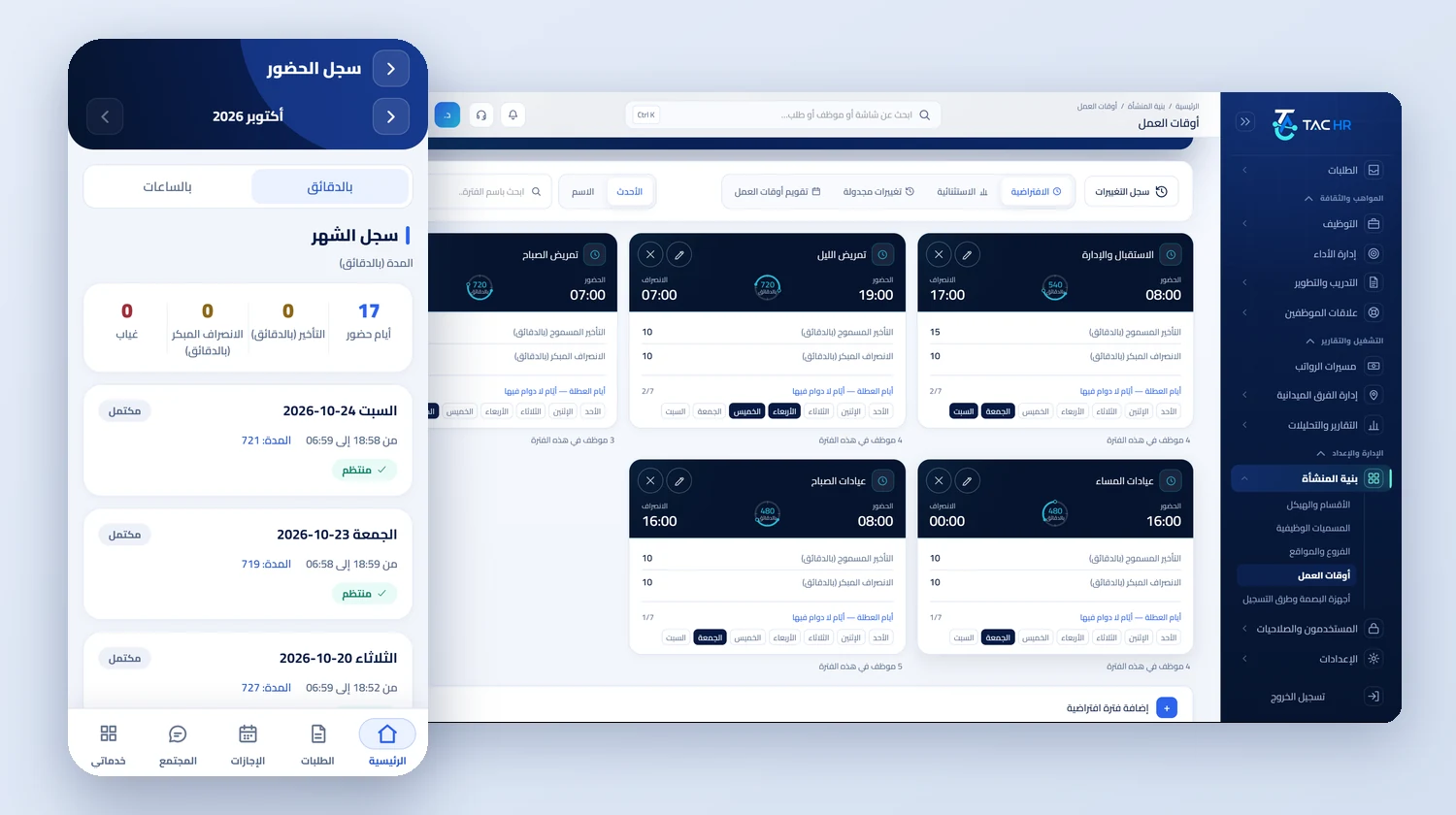
Inside the platform
A clinic does not only ask whether an employee came in, but whether they came in on their shift and from their place of work. A doctor has a clinic schedule, a nurse has a rotation that crosses midnight, a lab technician has turns that follow the analysers, and all of them may cover more than one branch. So TAC HR builds attendance on the shift assigned to each employee, not on general company hours, works out lateness, early leave and overtime on that shift, and sends what it worked out to payroll as separate lines. This page explains how that runs in a medical complex and what stays outside the system.
01
A shift for each group, even past midnight
Each shift has a start and end time, a lateness grace, an early-leave grace and rest days of its own, and an employee can hold more than one base shift a day as long as they do not overlap in time, such as a morning shift and an evening one. A night shift starts at 23:00 and ends at 07:00 the next day, and its check-out punch stays open until three hours after its end, so it is not counted as forgotten. A nurse who arrives at 23:12 is 12 minutes late on the shift itself and not for a whole day, and if she leaves at 07:04 after a 30-minute break her net work is 442 minutes. That tells the manager whether the department needs cover from a colleague.
02
Whoever has not punched, and whoever is called in
Every hour an automatic job looks for anyone whose shift started more than the set delay ago, 120 minutes by default and never more than 360, who has not punched and has no leave and no attendance request for the day, and their direct manager gets one alert a day for each such employee, going to the attendance admins if they have no manager. The company can also turn on a reminder to the employee. For emergencies after the end of the shift the company allows a temporary work shift on the same day, a setting that is off by default, and picks how it counts: time recorded only, within working hours, or as overtime. Admins start the day with a 07:00 morning summary.
03
Changing hours and sick leave
An employee raises a work time change request by choosing one of the company's shifts, the request goes through the approval route, and on approval their shift changes. Sick leave has 120 days a year in three tiers: thirty at full pay, then sixty at three quarters pay, then thirty unpaid. Someone who takes 45 sick days in one year has the first thirty at full pay and the following fifteen at three quarters pay, so 25% of the day's pay is deducted for each of them as a separate line in the run. Leave days are counted the way the company's balance counts them, and the counter starts from zero every first of January.
04
Licences and medical insurance
A practitioner's documents are uploaded to their file each with its expiry date, among them the professional card or Commission classification, the health certificate and the work permit, alongside the iqama and the contract end in their record. Each document moves through its stages on the company's lead times, 60, 30 and 7 days by default and then expiry, and admins receive one daily summary, while whoever's document expires raises a document renewal request of its type. The system does not connect to the commission, so the alert rests on the date entered. Medical insurance has policies with classes and dependants, and the employee's share enters the run as a separate line unless they are exempt.
05
Overtime and reviews
The overtime source is an explicit setting: approved assignments only is the default, so only time approved by an overtime request is paid, while the attendance log option pays whatever goes past the shift's end. The basis is basic pay or gross pay by the company's setting. On a gross basis, a nurse on a SAR 7,000 basic and SAR 1,750 housing has a normal hourly rate of SAR 36.46 and an overtime hour of SAR 51.04, so six approved hours appear as a separate line worth SAR 306.25. Reviews have templates for different groups with weighted criteria, a self-review, an anonymous 360 review, an end-of-probation review, and an improvement plan with tasks for whoever needs support.