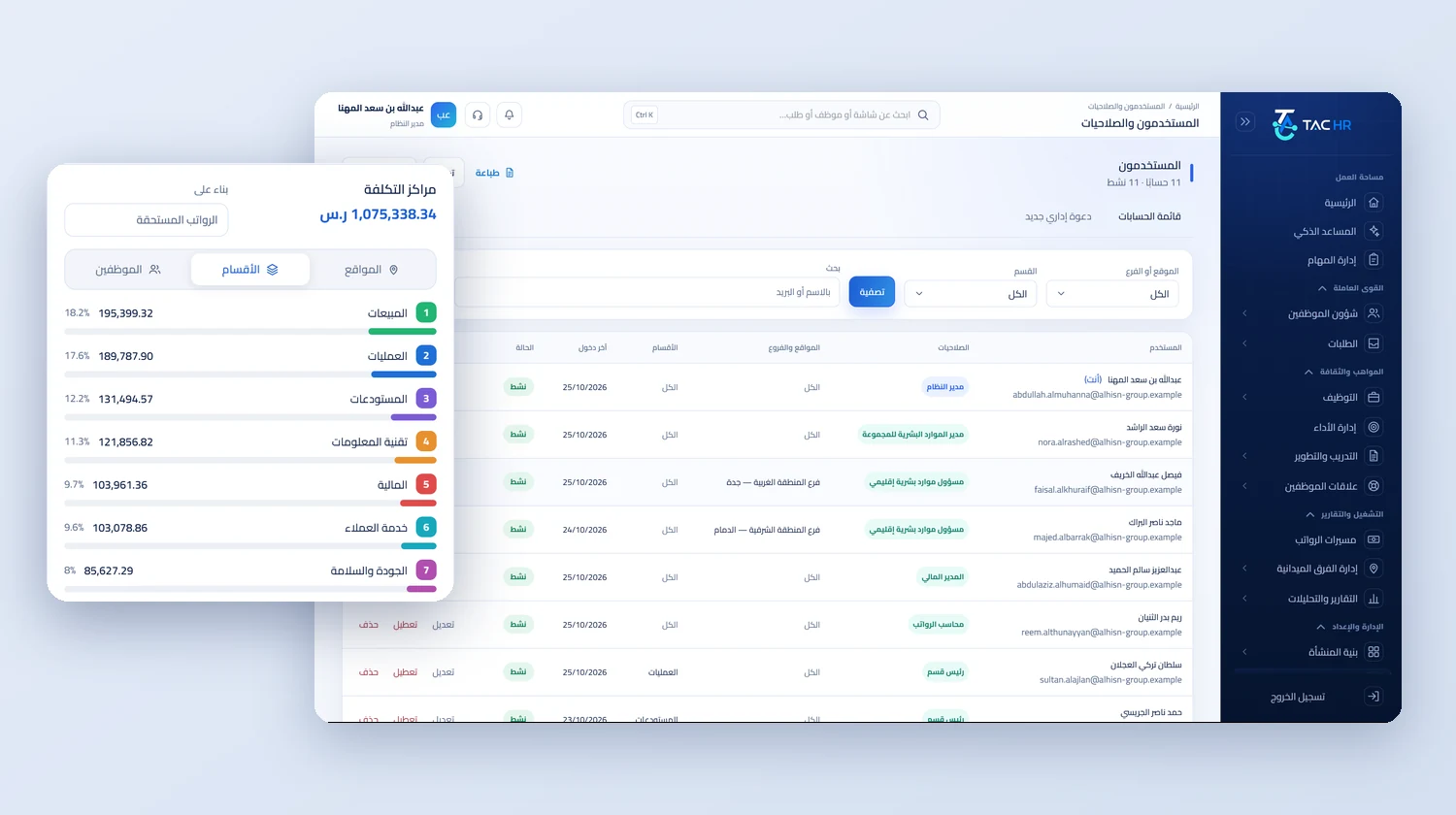
Inside the platform
A large company asks questions a small business does not: who sees what and why, how we prove who changed what, how our figures reach our other systems, how we make sure our data does not mix with anyone else's, and what happens to our backups. This page answers each of them with what TAC HR actually does and what it does not, so HR, finance and information security teams can carry it into the decision meeting without reading between the lines.
01
Who sees what
An admin account is given a scope of one or more branches or departments, and branch and department combine with an or: whoever is assigned to the Jeddah branch and the Finance department sees the staff of either. An empty scope means the whole company, which belongs to the holder of the full permission. The company creates admin groups with their permissions and copies, edits and deletes them, so each manager gets what belongs to their screen and action. Run visibility is a separate choice: all admins with the permission, or only the approval chain's members, its creator and the system admin, and the payment permission does not bypass it. Every change goes through one audit entry point with who made it and what it was before and after, so what left no trace did not happen.
02
Several companies and data isolation
One account may hold several companies, and each company has its own commercial registration, its number with the Ministry of Human Resources and its payroll IBAN, so the wage file comes out under its own header. Each admin account is bound to its company, and the session takes its authority from the live row, not from the cookie alone: a payload claiming a company other than its owner's is rejected, and an account with no company inside a multi-company account is not guessed a company but has its session rejected. Each company's data is isolated from the others in every query. What needs a unified view of several companies on one screen is not something this page promises.
03
The read API
Keys are created with scopes from three: read employees, read attendance and read the payroll summary. A key is stored only hashed, not encrypted, so we can never read it, and it is shown once at creation, and whoever loses it revokes it and creates another. Its scope is read from its row, not from the request, and the company is taken from the key, not from the request either. There are no pay fields in the employee read. The request limit is 120 a minute per key. It is read-only, so your external system pulls and does not write. As for accounting, the export is a journal entry file with your company's account codes that you import into your software.
04
Web notifications and import
You register an address that receives six events: employee created, employee terminated, request approved, request rejected, payroll paid and punch rejected. Rejection is an event like approval, because an outside system waiting on a decision is not helped by knowing only about approvals. The signature covers the timestamp, not the body alone, so whoever captured an old call gains nothing by replaying it a month later, and the address is https only. In import the system reads a file of up to five thousand rows and checks each row on its own with a preview before any write, so a bad row does not sink the whole file, and nothing is written until the admin confirms.
05
Security and continuity
The sign-in attempt limit is stored in the database, not in the memory of one instance, so it is not bypassed by reaching another instance, and a legitimate user is not locked out: the counter clears at the first successful sign-in. Device binding is strict by default for everyone: signing in from a phone other than the bound one is blocked and a device change request is shown to management. The app rejects spoofed locations, emulators and modified devices before every punch. Database backups are uploaded only encrypted with a private key to a storage container for backups alone, and decrypting them is measured by a test that encrypts, then decrypts, then compares the bytes, because a backup that does not decrypt is not a backup.