TAC HRTAC HR
A restaurant manager talks to three of his team in matching uniforms inside the dining room
Industry solution

Attendance System for Restaurants and Cafes

Two shifts a day with partial absence counted in minutes, certificates and iqamas alerted before expiry, and peak overtime with its formula

A restaurant works two days in one: lunch and dinner with a break between. TAC HR gives the employee two shifts a day and counts lateness on each, does not treat the gap between them as overtime, alerts before iqamas and health certificates expire, and produces payroll from the same record.

Today's reality

What happens in this industry without a system

  • 01A cook starts at noon, leaves after lunch and returns in the evening, so a day's punches turn into a sheet where nobody can tell who was late for which shift
  • 02An employee misses the whole dinner shift on a day they worked lunch, so it is logged as a full day's absence or not logged at all, with nothing in between
  • 03Staff iqamas and health certificates expire on scattered dates through the year, and whoever tracks them in a manual sheet misses one
  • 04A cook is absent on Friday night, so the schedule is changed hours before opening with no early knowledge of who is on approved leave
  • 05Half the team leaves in the break between shifts and comes back, so the gap is counted as work or lateness depending on who writes the sheet
With the platform

What changes in your working day

  • Two shifts a day

    An employee gets more than one primary shift that do not overlap, such as lunch from 11:00 and dinner from 18:00, and lateness is counted at the start of each with its grace.

  • The gap is not work

    The break between the two shifts is never counted as overtime even if someone punches in it, and overtime is counted after the end of the last shift of the day.

  • Partial absence in minutes

    Whoever misses a whole shift on a day they worked another gets a partial absence in its minutes, not a full day's absence, and what an approved permission covered is not counted as missed.

  • A device at the back door

    A ZKTeco device for the busy kitchen with a private key per device, and a punch from the phone inside the restaurant boundary for whoever carries one.

  • Iqamas and certificates alerted

    Iqama, health certificate, medical insurance and contract alert admins 60, 30 and 7 days before expiry in one daily summary.

  • Friday peak and overtime

    The manager sees approved leave on a timeline before changing the schedule, and overtime runs on approved assignments with its formula on the payslip.

Inside the platform

How it actually works in your company

A restaurant works two days in one: a lunch shift and a dinner shift with a break between, when half the team steps out. That rhythm is what confuses any attendance system built for one continuous shift, so the gap is counted as work or lateness and a missed dinner is logged as a full day's absence. So TAC HR builds attendance on the shift rather than the day: two shifts for the employee in a day, lateness and early leave at each, and a partial absence in the minutes that were missed. Around that sit the documents that expire, peak overtime and payroll. This page explains how that runs in a restaurant or cafe, and what the system does not do.

01

Two shifts in a day

An employee can hold more than one primary shift at the same time, such as lunch from 11:00 to 16:00 and dinner from 18:00 to 23:00, provided they do not overlap in time, and the system checks that when they are assigned. The day's schedule is the union of its shifts: lateness is counted at the start of each shift with its grace, and early leave at the end of each with its grace. Every punch is attributed to the shift it touches, or otherwise to the nearest one. A cook who arrives at 11:05 for a shift that starts at 11:00 is counted 5 minutes late on the lunch shift alone, and that does not touch dinner. A day with a single shift is still counted by it alone, like a one-shift employee.

02

The gap and partial absence

The break between the two shifts is never overtime even if someone punches in it: overtime is counted after the end of the last shift, and before the start of the first by a separate setting. Whoever misses the whole dinner shift on a day they worked lunch gets a partial absence in the minutes of that shift rather than a full day's absence, and whatever an approved permission covered is not counted as missed. The deduction is the day rate times the missed minutes over the day's scheduled minutes: a cook on a SAR 2,700 basic has a day rate of SAR 90.00, and missing 300 of 600 minutes costs half a day, which is SAR 45.00 with its formula on the payslip. A day on which both shifts are missed is a full day's absence as before.

03

The peak and overtime

On Fridays and after occasions demand rises, so the restaurant manager sees on the leave report a timeline of what has been approved and what is coming, and adjusts the shifts before opening. If work is needed after the shift's end, the overtime source is an explicit setting: approved assignments only is the default. Under the Saudi labour law model on basic pay, an overtime hour is paid at 1.5 times the normal hourly rate: a cook on a SAR 2,700 basic has a normal rate of SAR 11.25 an hour, so six approved hours on a Friday night appear as a separate line worth SAR 101.25. An emergency shift within the same day is a setting that is off by default, with three ways to count it: record the time only, count it within work hours, or count it as overtime.

04

Iqamas and certificates

Most of a restaurant's team are resident workers, so iqama and certificate dates are scattered through the year. A daily job at 06:00 checks the iqama, passport, medical insurance and contract-end dates in each employee's file, and the uploaded documents that carry an expiry date, including the health certificate. Every document moves through its stages on the company's lead times, 60, 30 and 7 days by default and then expiry, and admins receive one daily summary of what entered a new stage, while the employee gets a notification for their personal documents. Whoever's document is expiring raises a document renewal request of its type. The alert rests on the date entered in the file, not on a lookup at any official body.

05

The run

The run draft is created automatically on a day the company sets each month. It reads each employee's attendance by shift, lateness, partial absence, overtime and approved requests and writes every line with its formula. For a resident worker the employer carries occupational hazards alone, at 2% of the contributory wage, and nothing is withheld from the worker. Before export the wage file page checks IBANs, IDs and the company number, and alongside it comes a journal entry with your account codes, while the payslip reaches every employee's phone when the run is paid. The payroll cost report groups the cost by branch if the restaurant has more than one.


Inside the interface

The screen as your team uses it

Attendance System for Restaurants and Cafes
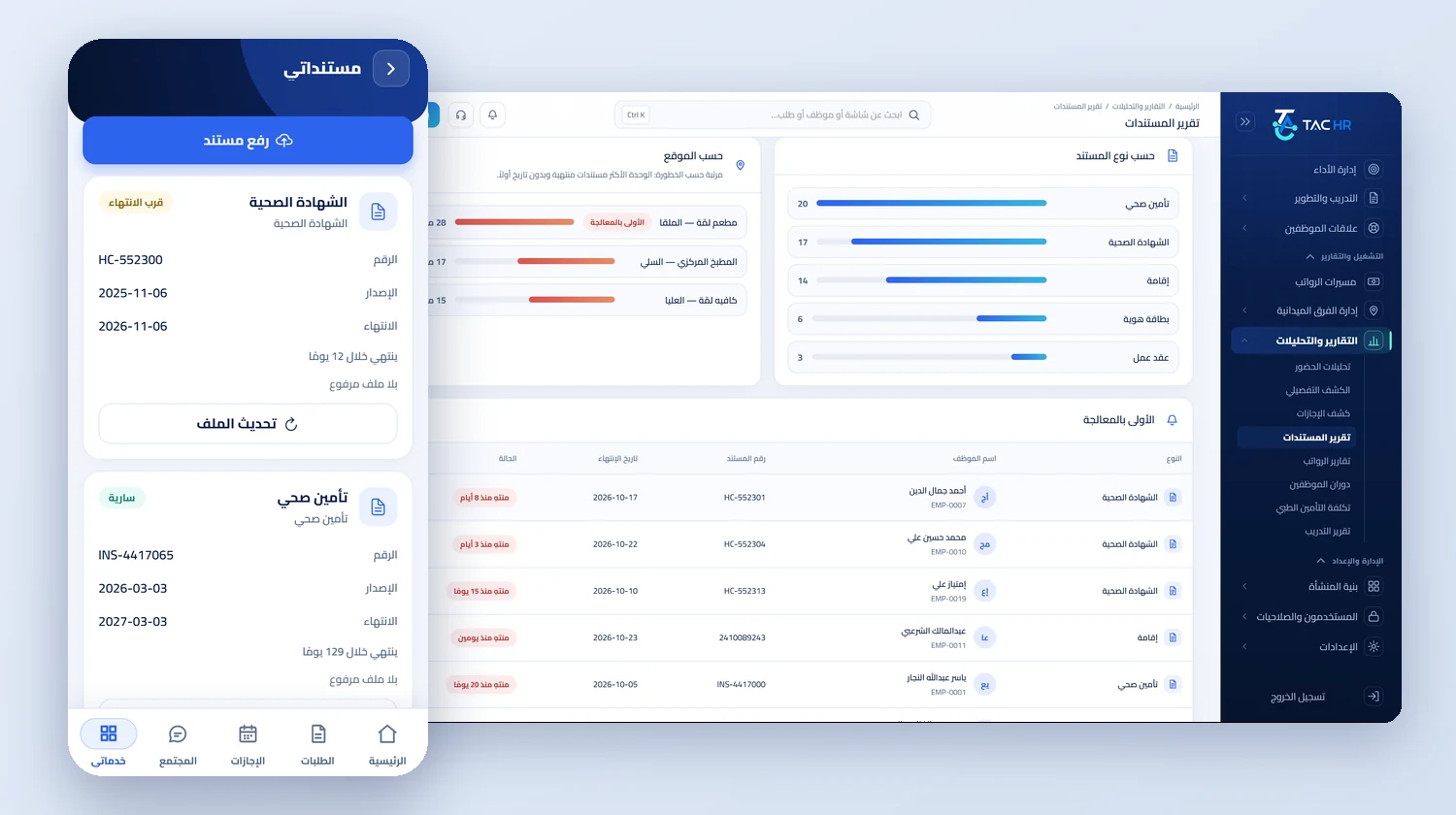
The documents report with the count of documents by type (health insurance, health certificate, residency, ID card and work contract) and by location, and a table of the documents to handle first with expiry dates and days since expiry, next to the my documents screen in the employee app with each document's issue and expiry dates
The right services

The services this business relies on

All services
An operating day

How the day runs on the platform

  1. 01

    Before opening

    The lunch and dinner shifts are defined and assigned, the kitchen device is connected if there is one, and the manager sees the week's approved leave

  2. 02

    The lunch shift

    The team punches inside the restaurant boundary, lateness is counted on the lunch shift alone, and the manager is flagged anyone who has not punched within the set grace after it starts

  3. 03

    Between the shifts

    The break stays outside overtime, then the team punches for dinner, and whoever does not return gets a partial absence in its minutes

  4. 04

    Month end

    The run draft is created, the partial-absence and overtime lines are reviewed, and the payslip reaches the employee's phone when the run is paid

The numbers

What the system works out for you

The figures come from a hypothetical example, computed by the system's own functions. The effect on your company is something you measure after rollout.

SAR 45.00
The partial-absence deduction for a cook who missed the whole dinner shift, which is 300 minutes of a 600-minute day, on a SAR 2,700 basic: half a day at a day rate of SAR 90.00
SAR 101.25
Pay for 6 approved overtime hours on a Friday night for a cook on a SAR 2,700 basic, at an overtime rate of SAR 16.88 an hour shown with its formula on the payslip
60, 30 and 7
The alert days before a health certificate that expires on 10 February 2027: admins are alerted on 12 December 2026, then 11 January, then 3 February

Limits of what the platform offers this industry

A punch is never recorded without an internet connection, so a restaurant with no coverage needs a connection before the shift starts. The system does not build the shift schedule or estimate how many people each shift needs: shifts are defined and assigned. The emergency shift within the same day is a setting that is off by default. The system alerts on the iqama and health certificate dates you enter and does not verify them with any body. The WPS file is a detailed table that comes out of the run after the checks and is not sent to any body, and GOSI is calculated and not paid from the system.

Industry questions

What this industry asks before deciding

Does the system record two punches for the same employee in a day?

Yes. An employee can hold more than one primary shift in a day with no overlap, each shift is counted on its own for lateness and early leave, and every punch is attributed to the shift it touches.

Is the break between the two shifts counted?

It is counted neither as overtime nor as lateness. The gap between two shifts is never overtime even if someone punches in it, and overtime is counted after the end of the day's last shift according to the overtime source the company sets.

How do I track health certificates for dozens of workers?

The certificate is uploaded to the worker's file in archiving with its expiry date, and admins are alerted 60, then 30, then 7 days before expiry in a daily summary. The system alerts on the date you enter and does not verify the certificate with any body.

What if the internet goes down at the restaurant?

A punch is never recorded without an internet connection, because the system checks the restaurant boundary and the device's integrity at the moment of the punch. A steady connection is needed at the start of each shift, and what was missed is recorded with a forgotten check-in request that goes through the approval route.

Request a demo on your own operation

We tailor the demo to your restaurant's shifts and team, and start with what throws you off today: the two shifts, iqamas and certificates, or overtime.