Inside the platform
A consulting, accounting or law firm's team hours are split between its office and its clients' offices: a consultant at the office in the morning and at a client's premises at noon. A firm that does not know where its team spent the week does not know what it is billing for, and it is at once trusted with its clients' secrets and its employees' data. So TAC HR is built on three things: office attendance and client visits inside a boundary, tasks with due dates for each file, and performance measured by cycles and an anonymous 360 review, all behind permissions that decide who sees what. This page explains how that runs in a professional firm, and what stays in your other tools.
01
The office and the client
An employee punches inside the office boundary like any other, and for someone who sometimes works elsewhere the punch place setting is set to anywhere, with the employee's setting overriding the company's. A client visit comes from the field tracking service on a seat for the consultant: they record their arrival at an approved client site, and the system judges the visit inside the radius, outside it or unconfirmed by the distance and the location's accuracy, with a radius of 150 metres by default that can be set between 20 and 2,000. The visit keeps its check-in and check-out times, duration, outcome, notes and photos. The judgement is made only against a site the manager approved, so a site an employee added waits for approval. The attendance sheet can be printed or exported as a spreadsheet file.
02
File tasks and leave
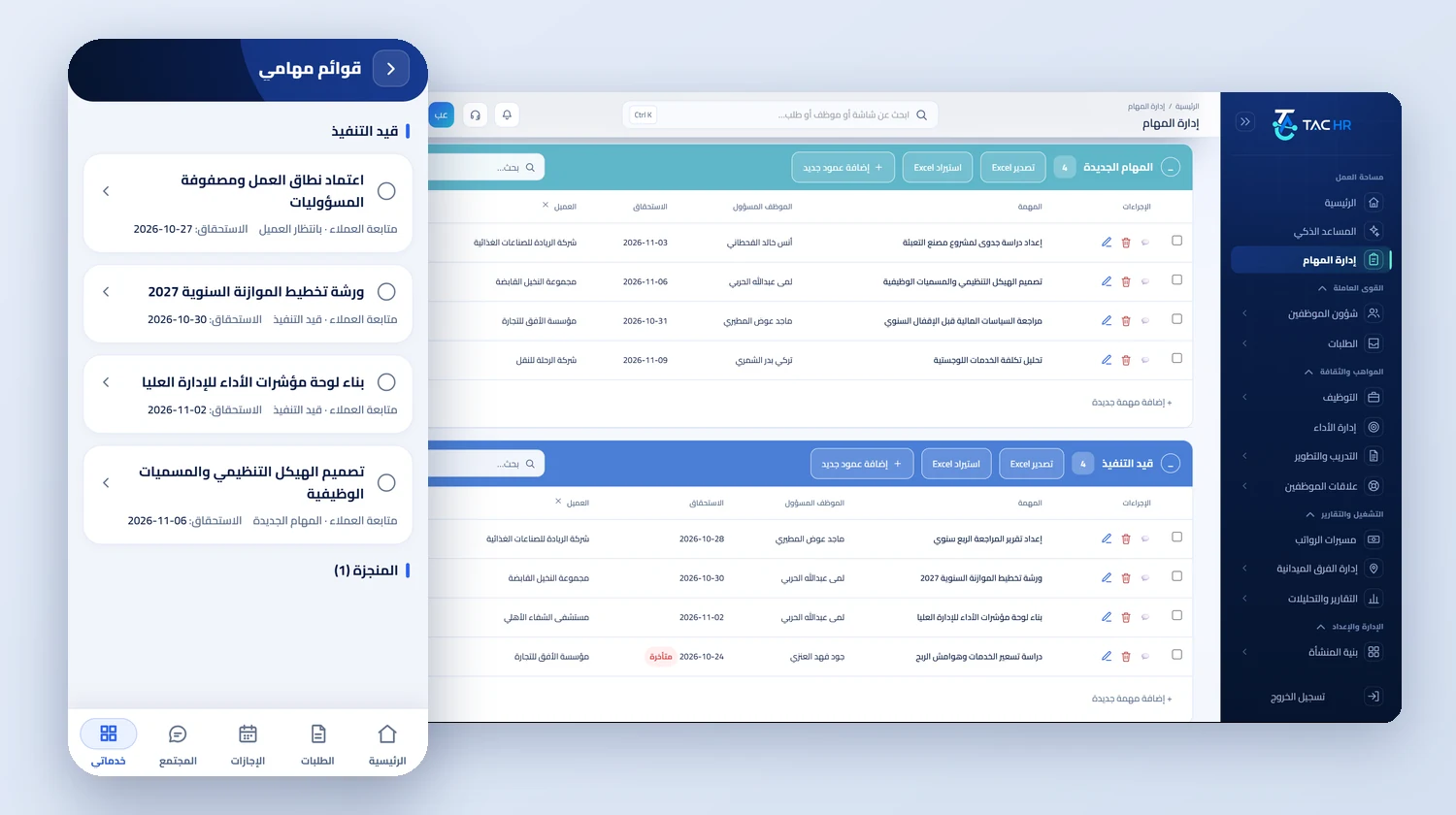
The tasks section has a ready template called Client follow-up with a client column and a request status of new, in progress, waiting for the client or done. A task is assigned to an employee with a due date, and they get a reminder the day before it and another on the day, and if it reaches the configured escalation grace, two days by default, the escalation goes to the task's creator and the employee's direct manager. The employee completes it from their phone and comments on it. In the peak season a leave request goes to the partner as the direct manager in a step of the route, and on the leave report the partner sees a timeline of what is approved and what is coming, so they know which files are affected by each consultant's absence before approving.
03
Performance and development
The annual review cycle uses weighted criteria from ready templates, including general employee, manager and sales, with goals and key results that feed the goals criterion. The 360 review is anonymous: the reviewer is never identified in any view, and under three reviewers no score, breakdown or comments are shown, and comments are sorted alphabetically rather than by arrival. So a consultant reviewed by four people who gave 80, 86, 90 and 84 averages 85. Whoever holds the calibration permission sees each reviewer's deviation from the cycle average and adjusts the score with a written reason. An employee raises a training course request through an approval route, and specialist certificates are uploaded as documents with an expiry date so admins are alerted before it.
04
Confidentiality by permission
The company creates admin groups with permissions it picks from a catalogue by module and action, and gives an admin account a scope of one or more branches or departments, so its work is limited to their employees. In reviews, the holder of the edit permission manages everyone, and otherwise the cycle's reviewer or the employee's direct manager does. A run's visibility can be set to its approval chain only, so its approval chain members, its creator and the holder of the full permission alone see it, and the payment permission does not bypass it, nor does its payslip, printout or bank file. The audit log records who did what, when and what it was before, and the trace is written in the action's own transaction so there is no action without a trace.
05
The run and hiring
The run draft is created automatically on a day the company sets, and both GOSI shares are worked out by the employee's system on the contributory wage up to its cap of SAR 45,000: a senior Saudi consultant on SAR 60,000 in the October 2026 run under the new system has SAR 4,837.50 withheld at 10.75%, and the company carries SAR 5,737.50 for them. When a consultant on SAR 12,000 has their contract end after three full years, their award is worked out at half a month for each year, which is SAR 18,000.00. Hiring has a jobs page and apply link, screening with a score and reasons that rejects nobody, interviews with a calendar invite, and an offer with a one-time reply link.