



01When to use the cleaner job description, and who uses it
This description is used by an office's administration officer, a private school principal or a clinic complex manager when hiring a cleaner directly, or when taking a cleaner from an operations company and agreeing with that company on what is expected. The services supervisor uses it in daily follow-up, because the standard here is a written schedule that can be checked, not an impression of how clean the place looks.
It is reopened when the building or the way of working changes: a move to larger premises with more floors, a staff kitchen added, or cleaning moved to after working hours. If the cleaner comes from an operations company, the description is attached to the contract with that company, while the employment contract itself stays between the worker and their employer.
02The cleaner job description
This text sets out the cleaner's duties in 5 groups, Offices and corridors, Washrooms and kitchenettes, Waste, Materials and tools and Safety and reporting, then the performance indicators, qualifications, skills and working conditions.
[Company name]
Job Description

Job title: Cleaner
Department: Support Services
Reports to: Services Supervisor / Administration Officer
Work location: [building and the assigned floors]
Work pattern: [full-time / part-time / by the work-period schedule]
Issue date: [date]      Version: [number]

Job summary
The cleaner keeps the building and its facilities clean and tidy to the cleaning schedule, uses the assigned materials and tools safely, disposes of waste and reports what needs repair.

Duties and responsibilities
1) Offices and corridors
   - Sweep, wash and polish floors to the schedule.
   - Wipe surfaces, desks and inside windows.
   - Empty waste bins and change their liners.
2) Washrooms and kitchenettes
   - Clean and disinfect washrooms and basins.
   - Refill soap, tissues and supplies.
   - Clean small kitchens and hospitality rooms and sanitize surfaces.
3) Waste
   - Collect waste and carry it to the set areas.
   - Sort what needs sorting under company instructions.
   - Never leave waste in corridors.
4) Materials and tools
   - Use cleaning materials as instructed and at the dilution required.
   - Never mix chemicals.
   - Keep tools and materials in place and tell the supervisor when they run out.
5) Safety and reporting
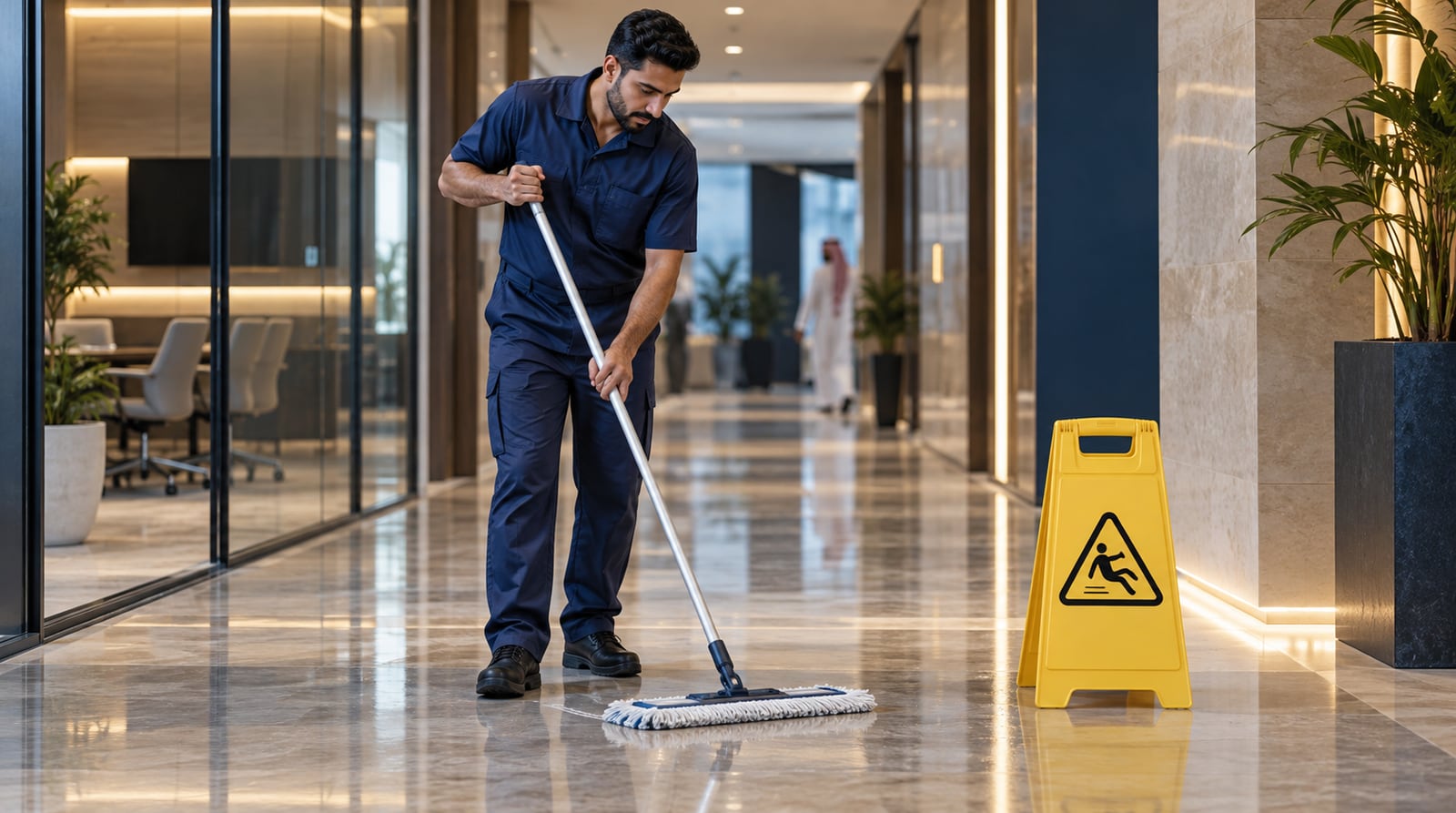
   - Put out a warning sign at wet floors.
   - Wear gloves and suitable footwear.
   - Tell the supervisor about a fault, a leak or anything missing.

Suggested performance indicators
- Cleaning schedule completed on time.
- Level of cleanliness at routine checks.
- Supplies available in washrooms.
- Following safety instructions.
- Speed in reporting faults.

Qualifications and experience
- No specific academic qualification [or what the company sets].
- Earlier cleaning experience [if required].
- Physical fitness for moving and lifting.

Skills required
- Care and attention to detail.
- Knowing the materials and using them safely.
- Keeping to the schedule.
- Courtesy with staff and visitors.
- Honesty with anything found.

Working conditions
- Work location: [building], moving between floors.
- Physical effort: standing, bending and carrying equipment.
- Equipment: cleaning kit and materials in the cleaner or supervisor custody.

Approval
[Approver name and job title]      Signature: ________      Date: [date]

Job holder acknowledgment
I have read the cleaner description above and confirm I understand its duties.
Name: [employee name]      Signature: ________      Date: [date]
03The cleaner description, clause by clause
Offices and corridors: the schedule is the standard
The clause refers to the cleaning schedule: what is cleaned daily, what weekly such as windows and carpets, and what seasonally. A schedule posted on the store-room door turns the review into one question: was what is on the schedule done?
Washrooms and kitchens: several times a day
Washrooms in an office of fifty people need cleaning more than once a day, so write how many times and when. A small log on the door, with the cleaner's signature and the time, is the simplest proof of work.
Waste: sorting and collection time
Collecting waste from offices and taking it out in time for collection, and separating what the company asks to be separated, such as paper and cardboard. Medical or chemical waste in clinics and laboratories has its own procedure that a general cleaner does not handle without training.
Materials and tools: who supplies and who orders
The clause states whether materials come from the company or the operations company, and that the cleaner reports before they run out. Using materials according to their instructions and never mixing them is a safety clause, not a cleanliness one.
Safety, reporting and qualifications
The cleaner reports faults, leaks and wet floors and puts out the warning sign. The qualification is usually basic reading and writing, physical fitness and honesty, because the cleaner enters offices while their owners are away.
Approval at the end of the template
The cleaner description does not take effect until the approver signs and dates it, and the version number tells the current copy from the last one at every change.
04Interview questions that test the cleaner description
- 01You enter an office and find papers and a wallet on the desk. What do you do? Does not touch them, cleans around them, and tells the supervisor if the office was left open with nobody there.
- 02The disinfectant runs out halfway through the day. What do you do? Tells the supervisor at once and does not replace it by mixing other products.
- 03How do you clean a washroom between users at the busiest hour? Quickly and in a fixed order, with the wet-floor sign, and logging the time.
05A filled-in example: a cleaner at a company office in Riyadh
A consultancy in Riyadh directly hires a non-Saudi cleaner reporting to the administration officer. The company wrote a daily schedule for the three floors, added that the cleaner enters the server room only when accompanied, and that the company supplies materials. As the cleaner is not Saudi, nothing is deducted for GOSI, and the company estimated twenty-four hours of overtime a month for cleaning after events, all paid at the overtime rate.
| Field | In the example |
|---|---|
| Company | A consultancy's three-floor office |
| City | Riyadh |
| Work period | Morning, 6:00 am to 2:00 pm |
| Start date | 2026-11-29 |
| Nationality | Non-Saudi |
| Basic salary | SAR 1,800.00 |
| Housing allowance | SAR 450.00 |
| Transport allowance | SAR 200.00 |
| Total monthly salary | SAR 2,450.00 |
Entering these cleaner numbers in the overtime calculator, the GOSI calculator, the end-of-service calculator and the leave calculator returns the same results:
| Calculation | Result | Basis |
|---|---|---|
| End of probation (90 days) | 2027-02-26 | the start date counts as day one |
| Actual hourly wage | SAR 10.21 | (basic + allowances) ÷ 30 ÷ 8 hours |
| Overtime hourly rate | SAR 13.96 | actual hourly wage + 50% of the basic hourly wage |
| Pay for 24 overtime hours | SAR 335.00 | overtime rate × hours |
| Employee GOSI share per month | SAR 0.00 | nothing is deducted from a non-Saudi employee |
| Employer GOSI share per month | SAR 45.00 | 2% of the contributory wage |
| End-of-service award if the contract ends at term after two years | SAR 2,450.00 | half a month's wage per year for the first five years, on the total of SAR 2,450.00 to 2028-11-28 |
| Annual leave earned by the end of probation | 5.18 days | 21 days per year of service, pro rata |
06Hard cases and common mistakes in a cleaner description
A worker from an operations company falls short
The company does not discipline a worker who is not its employee; it records the issue and notifies the operations company under the contract with it. That is why the description and schedule are attached to the operations contract, so shortcomings are measured against what was agreed.
Lost property found while cleaning
The cleaner hands what is found to the supervisor or reception, and it is logged with date and place. The description makes this a duty, which protects the cleaner from any later accusation.
An employee asks for their office to be cleaned off schedule
Special requests go through the supervisor, who decides according to the time available, so the cleaner does not abandon the schedule to serve whoever asks first.
Common mistake: A description with no schedule
“Keeping the building clean” cannot be measured. The schedule is the real description of the work, so attach it.
Common mistake: Assigning dangerous work without training
Cleaning glass façades from outside or handling concentrated chemicals needs training and equipment, and is not added to a general cleaner's description in one line.
07Steps to adapt the cleaner description to your company
- 1
Write the cleaning schedule
daily, weekly and seasonal, since it is the standard for review.
- 2
Say who supplies the materials
the company or the service provider.
- 3
Mark restricted areas
such as server rooms or labs and what is barred.
- 4
State the period
morning or after office hours, which changes how the work runs.
08Cleaner description checklist before approval
6 items
09Frequently asked questions
Both are common. If through a company, make the description an annex to the service contract.
State it in the description with who hands over the key and who logs the entry.
With a schedule the supervisor signs, and the cleaner clock-in recorded inside the building zone.
List the general types, and keep detail in the materials and safety sheet.
Yes, if employed by the company, because the Labor Law's leave provisions cover them. Details are on the annual leave page.
That depends on area, use and the number of washrooms. Start from the schedule, then estimate the hours needed to carry it out.
If the building needs it, put it in the work-period schedule and give the weekly rest day on another day. Work on the rest day at the company's request is handled as the Labor Law sets out under overtime.